
Know Why You Win
Then make it repeatable
Most teams can't say why their best deals actually close. That's the gap we close.
When your team can't articulate your unique value or explain why your best customers buy, everything gets harder: prospecting, onboarding, account growth, leadership alignment. All of it.
It starts with naming "What Good Looks Like Here," the specific behaviors and buying reasons behind your wins. That's the foundation of knowing why you win.
I help leadership teams understand what's actually working, sharpen their message, and build the systems that make performance repeatable.
Who This Is For
You’ll get the most value from this work if you are:
A VP of Sales, CEO, COO, or revenue leader responsible for growth
Leading a company between $30M and $250M+ (or operating with similar complexity)
Managing outside sales reps, field teams, or territory-based sellers
Frustrated by inconsistent performance, unclear messaging, or reliance on instinct
Looking for a partner who works hands-on, not a trainer who drops in and disappears
I work primarily with mid-market manufacturers and distributors: companies where growth has stalled, veteran knowledge is concentrated in a few key people, and leadership knows the team has more potential than current results show.
If that describes you, you’re in the right place.

“Do you have something worth talking about? Are you someone worth talking to?
If you can’t answer these questions, you need to work with Jeff.
He will walk you through every step required to be successful, from determining what makes you different from your competition to various ways to get in front of referral sources and maintain their attention.
Every aspect of his programs help you better understand yourself and where you get stuck during the sales/marketing process.
Jeff is THE BEST in the business when it comes to helping grow YOUR business!”
How We Work Together
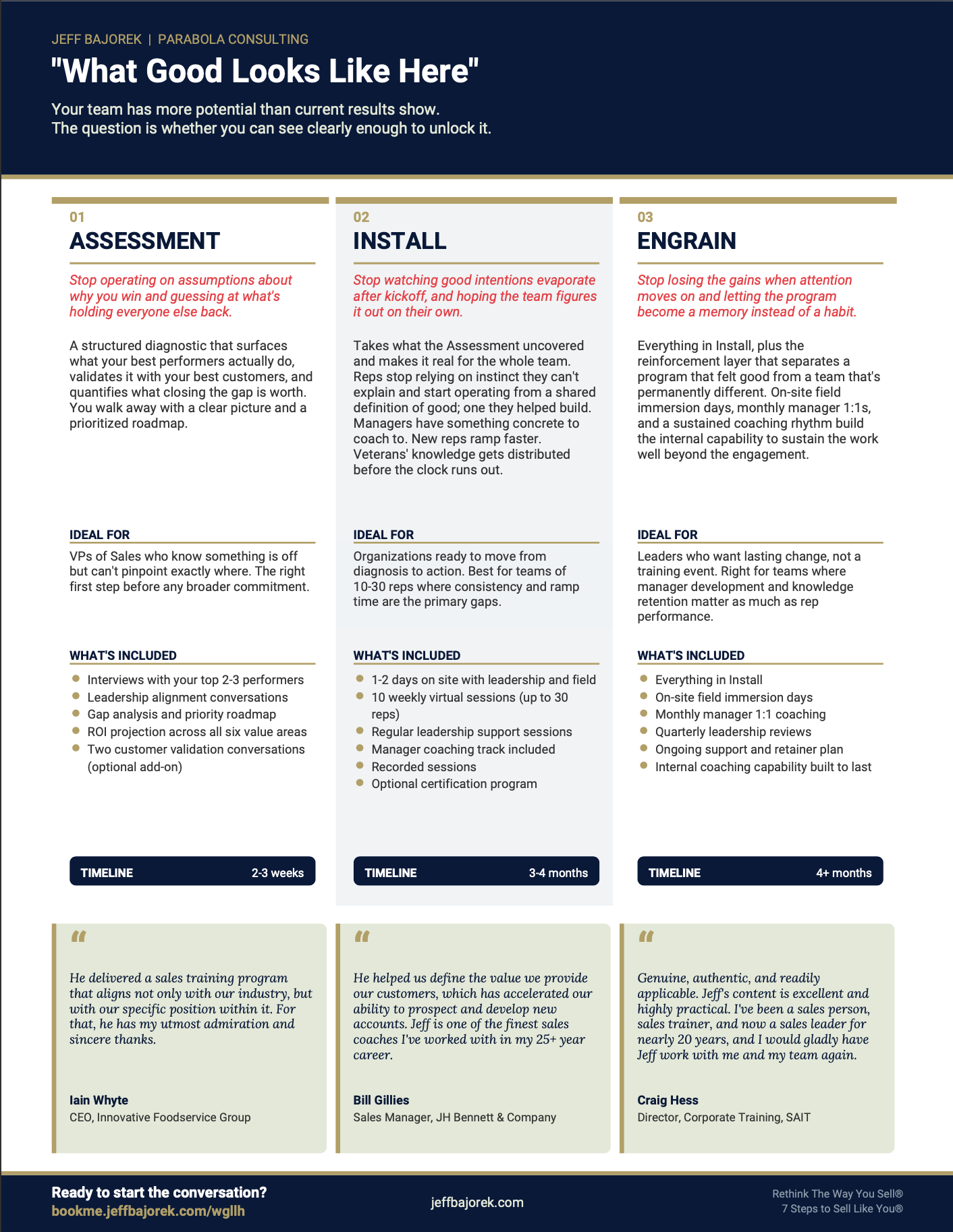
Every engagement begins with an Assessment that surfaces what your best people actually do, validates it with your best customers, and tells you what closing the gap is worth. From there, we move into Install and Engrain.
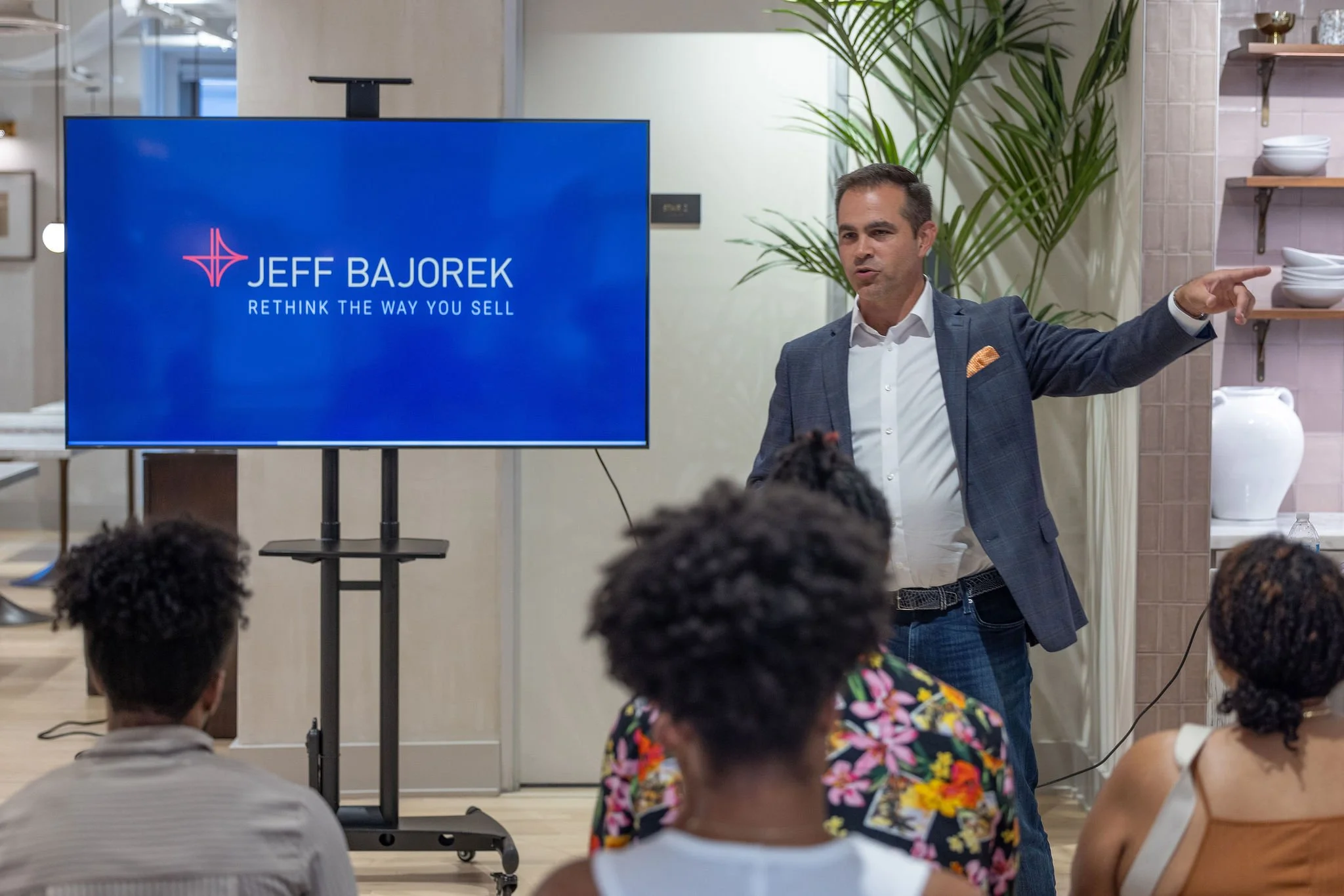
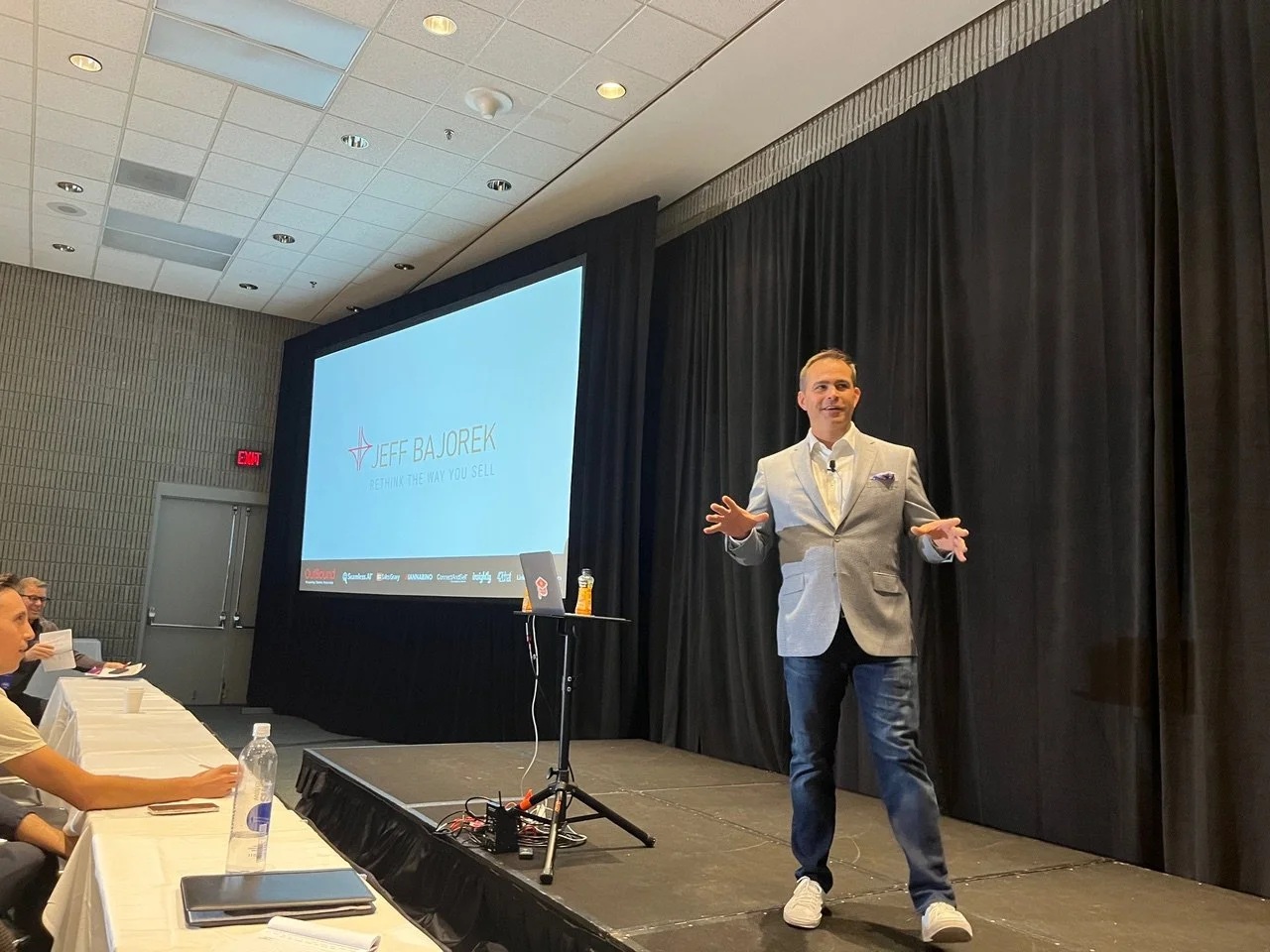
SKOs, Workshops & Keynotes
Shift how your sales team thinks before you try to change how they sell.
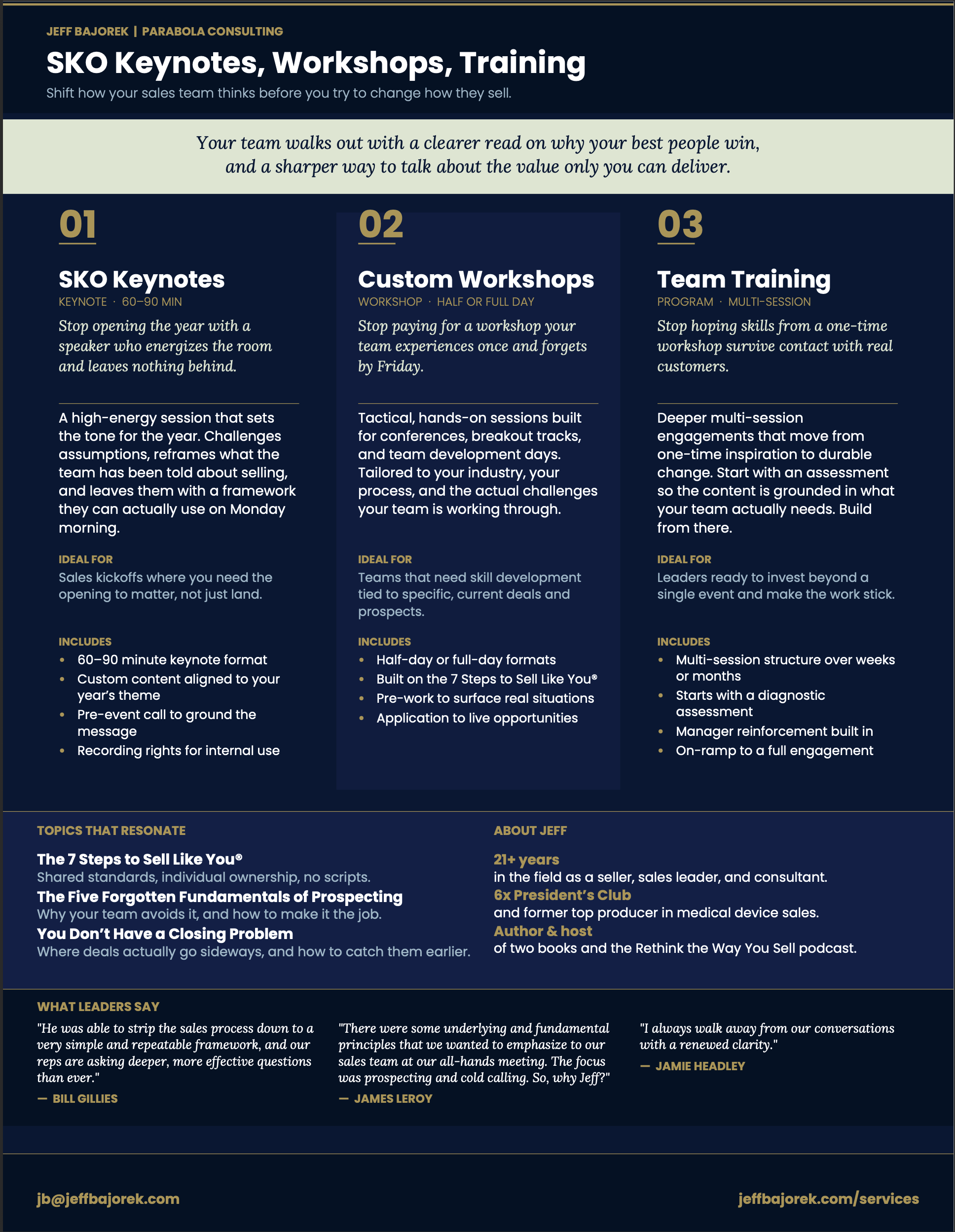
“There were some underlying and fundamental principles that we wanted to emphasize to our sales team at our all-hands meeting. The focus was prospecting and cold calling, the often-dreaded terms that sales teams fear. So, why Jeff?
First, he was willing, no, he wanted to dive in and get an understanding of our business even for a 1-day event.
Jeff brought a fresh set of eyes to our processes, how we did business and what we could do better. In all honesty, it was as if Jeff had been selling in our industry for years!
He treated our business as a unique case study in how we can improve upon where we are today, this speaks volumes to his dedication.
It wasn’t just a regurgitation of a presentation he’s given a thousand times; it was personalized.”
Frequently Asked Questions
-
Sales training teaches skills and techniques, such as handling objections, closing deals, and running discovery calls.
Sales consulting diagnoses why your team isn't performing and addresses the systemic issues that make training ineffective.
Most sales problems aren't actually skill problems. They're process problems, leadership gaps, territory issues, or organizational obstacles. Training can't fix those.
While I provide training programming for most of my consulting clients, it’s tailored and delivered within an ecosystem designed for it to be most effective.
-
A fractional VP of Sales is usually an ongoing leadership role. They're running your sales organization day-to-day, managing the pipeline, coaching reps, and making hiring decisions.
What I provide as a sales consultant is diagnosing specific problems, implementing solutions in focused sprints, and transferring ownership back to your team.
Consultants are intensive but temporary; fractional leaders are ongoing but spread across multiple companies.If you need strategic fixes with clear endpoints, consulting makes sense. If you need ongoing leadership capacity, fractional could be the answer.
-
Most sales training fails because it assumes the problem is skill gaps when the real issues are systemic: unclear processes, misaligned comp plans, territory problems, or leadership gaps.
You can teach someone better discovery questions, but if your comp plan rewards the wrong behaviors or your CRM is too complicated for your team to use, the training won't stick.
That's why assessment comes first. We’ll identify whether you need training, systemic fixes, both, or neither.
-
If your veterans consistently deliver but new reps struggle despite training and onboarding, that's likely systemic. Your successful people have figured out workarounds or operate on unconscious mastery that hasn't been documented.
If everyone struggles with the same stage of your process (like discovery or closing), that might be a skill issue.
But often what looks like a skill gap is actually an environmental problem: unclear process, conflicting priorities, or organizational obstacles.
A proper assessment reveals the difference in 2-3 weeks.
-
I call these “The Dirty Half-Dozen” - the systemic issues I consistently find that prevent training from working:
Poor accountability - insufficient leadership capacity to support and coach teams
Misaligned compensation - comp plans that reward the wrong behaviors
Wrong people in wrong roles - unclear role definitions between different sales positions
No strategic direction - unclear strategy that shifts quarterly or lacks focus
Reps misallocating time - too many accounts to manage strategically, or focusing on the wrong activities
Methods stuck in the past - not evolving with how buyers want to buy today
These aren't skill problems. They're organizational design problems that require systemic solutions, not training.
-
No. Here's why: If I show up with a pre-packaged solution before understanding your specific situation, I'm guessing. And guessing wastes your time and money.
The assessment ensures we're solving the right problems.
Your top performers have figured something out that works in your specific environment, but success patterns that develop organically are often invisible to the people executing them.
The assessment surfaces what's working, identifies what's missing, and creates a roadmap that respects your existing strengths while addressing the gaps.
-
A comprehensive sales assessment takes 2-3 weeks and includes:
interviews with 2-3 executive leaders
diagnostic conversations with 2-3 sales reps
a review of your systems (CRM, comp structure, territory assignments).
You'll receive a detailed diagnostic report with clear findings about what's actually preventing performance, a prioritized roadmap for what to fix first, and a 60-minute debriefing where we walk through recommendations together.
The goal is clarity. You'll leave with a better understanding of what your top performers do that the rest of your team doesn’t, and a plan to help integrate those patterns and behaviors.
-
Investment varies based on scope and team size.
A diagnostic assessment starts at $5,000 and can be completed as a standalone engagement.
Most companies continue into a training program built around my 7 Steps to Sell Like You® framework, which starts at $50,000.
Additional cohorts, extended timelines, or deeper field immersion add to the investment.
The right scope depends on your situation. We’ll build that together.
-
Behavioral change takes time, but most clients see immediate clarity after the assessment.
Measurable improvements in pipeline activity typically show up within 60 days of starting the implementation sprint.
Closed revenue impact depends on your sales cycle length.
The assessment itself often creates quick wins by identifying reliable patterns of success and obvious obstacles that can be removed immediately.
-
Both.
The assessment is usually done virtually, but can be done onsite.
Training is usually a hybrid of remote sessions and strategic onsite workshops. We design the right mix based on your needs and geography.
Given the amount of co-creation that goes into these bespoke training engagements, I try to get on-site for at least a day to work with executives and interact with the team.
Most clients find that a blend works best. Remote for regular coaching and check-ins, onsite for intensive workshops and key milestones. -
I specialize in B2B companies with relatively complex sales processes, typically 60-180 day cycles.
I've worked across manufacturing, technology, professional services, and distribution.
The principles of sales success are universal; the application is always customized to your specific market, buying process, and organizational dynamics.
I have deep roots in Detroit and a particular affinity for blue-collar, tangible-product businesses; the companies that actually make and move things.
-
PE portfolio companies often face sales challenges that contribute to their availability for acquisition: stagnant growth, overreliance on founder relationships, undocumented sales processes, or organizational obstacles that limit scale. These are often valuable businesses looking to modernize or professionalize to take the next big step.
Post-acquisition, these companies need to professionalize their sales function quickly to meet value-creation milestones.
A focused diagnostic assessment followed by a 3-month training engagement can accelerate improvements without the ongoing cost and commitment of fractional leadership.
This approach fits PE timelines and delivers measurable results within hold periods.
I've been referred by PE firms based on results at other portfolio companies. One CEO told a peer he'd hire me to run his sales organization. That's the level of understanding I bring to post-acquisition sales work.
-
Not usually. My focus is organizational sales performance for B2B companies with existing teams.
If you're an individual seller looking for coaching, I can recommend you to a few of my trusted colleagues that provide that service.
Ready to Get Started?
Every engagement begins with the Self-Assessment: a simple, targeted diagnostic that highlights your team’s biggest opportunities for clarity and improvement.
No pitch. No pressure. Just insight.
Once you complete it, we’ll schedule a Clarity Review Call to walk through your results together and discuss what’s really driving (or limiting) your sales performance.
If there’s a fit, we’ll outline next steps and get started within 1–2 weeks.
