What is Understood Doesn’t Need to Be Discussed. Except it Does.
Margin is leaking on deals you should be winning at full price. Your new reps are taking six extra months to ramp, if they ramp at all. Your best veterans are close to retirement, and what they know lives entirely in their heads. The team is busy, the number is moving, just not the way it should.
Nothing here is broken. That's part of the problem.
Most VPs of Sales reading that list are going to assume what they're seeing is just the cost of doing business. A bad quarter to push through, a new rep who needs more time, a veteran they'll figure out how to replace later. None of it feels urgent enough to dig into, because the company is still running.
But most companies are floating when they could be sailing, and every company I’ve ever worked with answers me the same way when I ask what they do differently, what they bring to the table, and why their best customers choose them.
“We have great relationships.”
“We really care about our customers' results.”
“We have a ton of industry experience.”
Those answers aren’t wrong, and they’re usually true.
They’re also useless.
Because if everybody says that, nobody says that.
If you can pick up the marketing copy from your three biggest competitors and find the same three claims in slightly different language, then they’re not differentiating you. They’re really just confirming that you and your competitors are operating in the same category. The prospect or buyer hears those words and their brain files them under "of course you would say that."
It just doesn’t land.
Still, those answers keep coming out… in conference rooms, on websites, in pitch decks, in introductions at networking events. Year after year. Team after team.
There are reasons for that.
Why those three answers come out
Three reasons…
The first is that those answers are true. The relationships, the care, and the experience are real. Saying them out loud does not feel like a lie because they’re not lies.
The second is that those answers feel personal and emotional. They feel different from features, specs, and price points. When a rep says "we have great relationships," there’s a feeling underneath the words. They are thinking about Jim, who’s been a customer for fifteen years, the dinner they had just a couple of weeks ago, and the way Jim called them first when his procurement team started asking suspicious questions. The rep is not lying. They’re describing a feeling.
The third is the one nobody wants to talk about. Digging deeper beyond those three answers requires work that feels small, pedantic, and uncomfortable. It requires being explicit about things that everyone in the room has been treating as obvious for years.
There is always a moment in those discussions, somewhere around the third or fourth pointed question, where someone looks across the table at a colleague and just says, "You get it, right?" The colleague nods, and the room moves on.
What is understood doesn’t need to be discussed.
Except it does.
What is actually happening underneath
Most reps can’t tell you why they win.
Not because they’re bad at their jobs… actually, the opposite. They’ve been winning for so long, on a combination of instinct*, history, and unconscious competence, that the things they do well have become invisible to them. Those instincts became the air they breathe. Fish do not know they swim.
This is the generous read, but I think it is also the accurate one. The team might be missing the number. That doesn’t mean they’re bad at their jobs. It means they have been winning on instinct for so long that those behaviors have become invisible, and nobody ever asked them to make them explicit. They’ve been understood, so they haven’t been discussed. The failure isn’t in their effort or their talent. It’s in the fact that what made them successful was never named, documented, or built to scale beyond the people who already had it.
The bigger problem is that the conditions have changed underneath them.
The way you built a relationship with a customer in 2005 is not the way you build one in 2026. Buyers evaluate risk differently. They show up to the first conversation informed. The competitive set is wider, and personnel turnover on their side is faster. Twenty years of accumulated relationship capital does not transfer to a stranger you met last week, and strangers are an increasingly large share of your pipeline.
The question isn’t whether your veterans are good. They are. The question is whether what made them good can survive being passed to people coming up in a different time.
*What looks like instinct in a veteran rep is not innate. It is thousands of repetitions in context, with feedback loops attached. The veteran has learned something real. They have just never been asked to put it into words. That is the work.
Pushing on “What We Do”
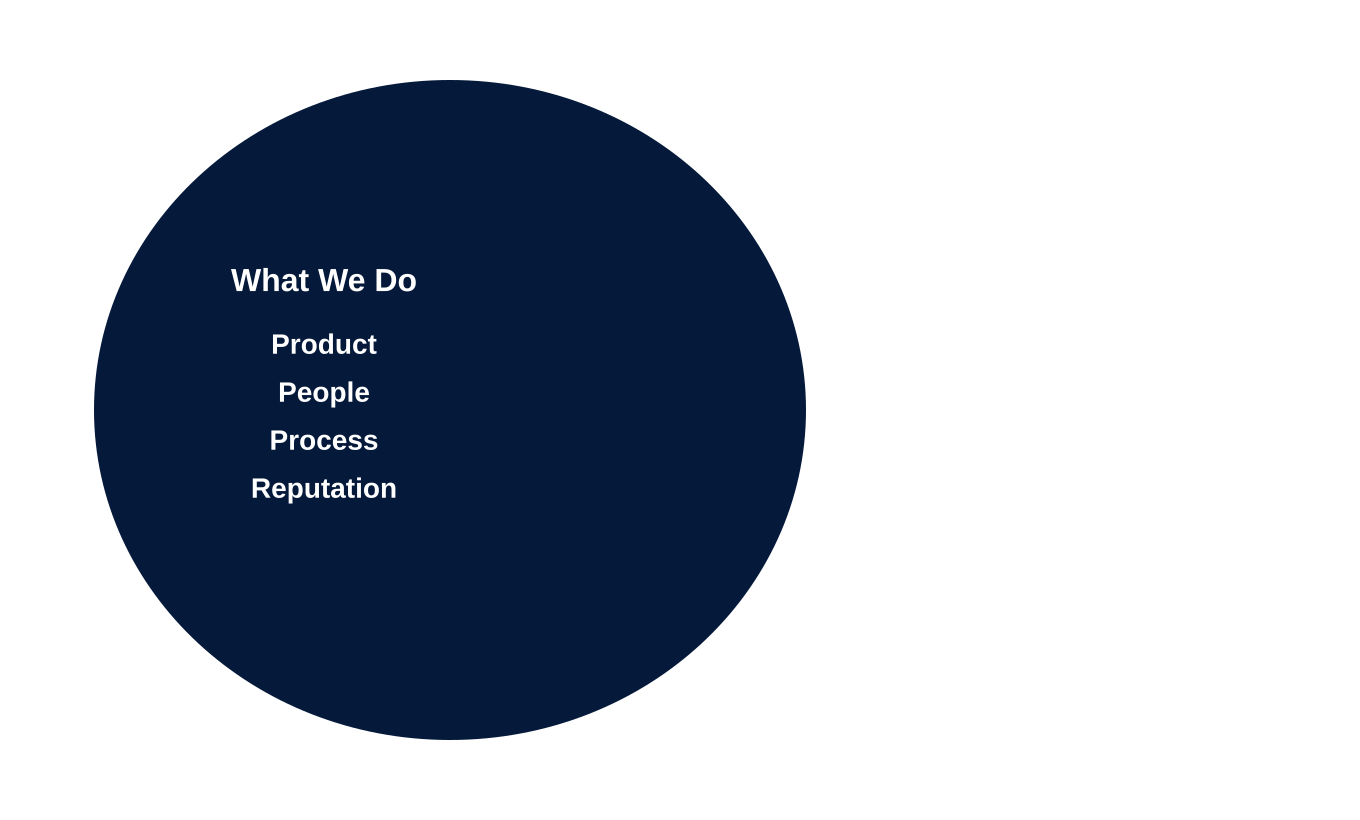
There are two questions every sales organization needs to answer with precision. The first is, “What do we actually do?”
When a leadership team tells me they have great relationships, I don’t nod and move on. I push.
How were those relationships formed? What was the first thing you did that earned the trust? If you had to start over today, with no referrals, no shared history, no twenty-year track record, how would you build that same relationship from scratch?
What do you actually mean when you say great relationship? Can you give me a specific example of one? Can you describe the moments that made it great, not the fact that it has lasted a long time?
When did one of those relationships actually pull through for you and mean something? Not when they renewed or placed a big order. When did the relationship itself do the work, in a moment that would have gone differently if it hadn’t been there?
Those questions feel small. They’re not. They’re the questions that separate a real differentiator from a sentimental one. If you can’t answer them, then "great relationships" is just a feeling you are carrying around, not a business asset you can teach, scale, or replicate.
The first time I bring those questions up in a room, the temperature changes. People get defensive.
Not because they are being caught in a lie (they’re not lying, remember?), but because they have never been asked to think about it this way, and now they are being asked to on the spot, usually in front of their boss and their peers.
Defensiveness isn’t resistance. It’s exposure. It’s what happens when somebody is asked to explain something they have always taken for granted. The discomfort is real, and it’s the price of admission. The moment you push past it, you start learning things you didn’t know an hour ago.
Strangers are the diagnostic, not the goal
Strangers are the litmus test.
Acquaintances will fill in the gaps for you. They have history with you, a reason to give you the benefit of the doubt. They'll nod when you say "great relationships, we really care, lots of experience," because they already know it from their own experience with you. The message doesn't have to do much work because the relationship is doing the bulk of it.
Strangers won't do that. They don't know you. They've never been to your office, and don't have a friend who vouched for you. A stranger has nine seconds, maybe less, to decide whether what you're saying is interesting enough to keep listening, and they will definitely not nod along with the same vague claims your competitors are making.
If your message holds up with strangers, it'll hold up with acquaintances. The reverse is not true. A pitch that works on acquaintances might be coasting on relationship goodwill that strangers will never grant.
So when I push a team on what they actually do differently, I'm not asking them to develop a cold outreach strategy. I teach warm before cold, and wrote a seven-part series on it. I'm asking them to develop a level of clarity that makes everything they already do, including the warm outreach, dramatically more effective. The precision strangers demand is the same precision that makes the relationships you already have work even harder for you.
Pushing on “Why They Buy”
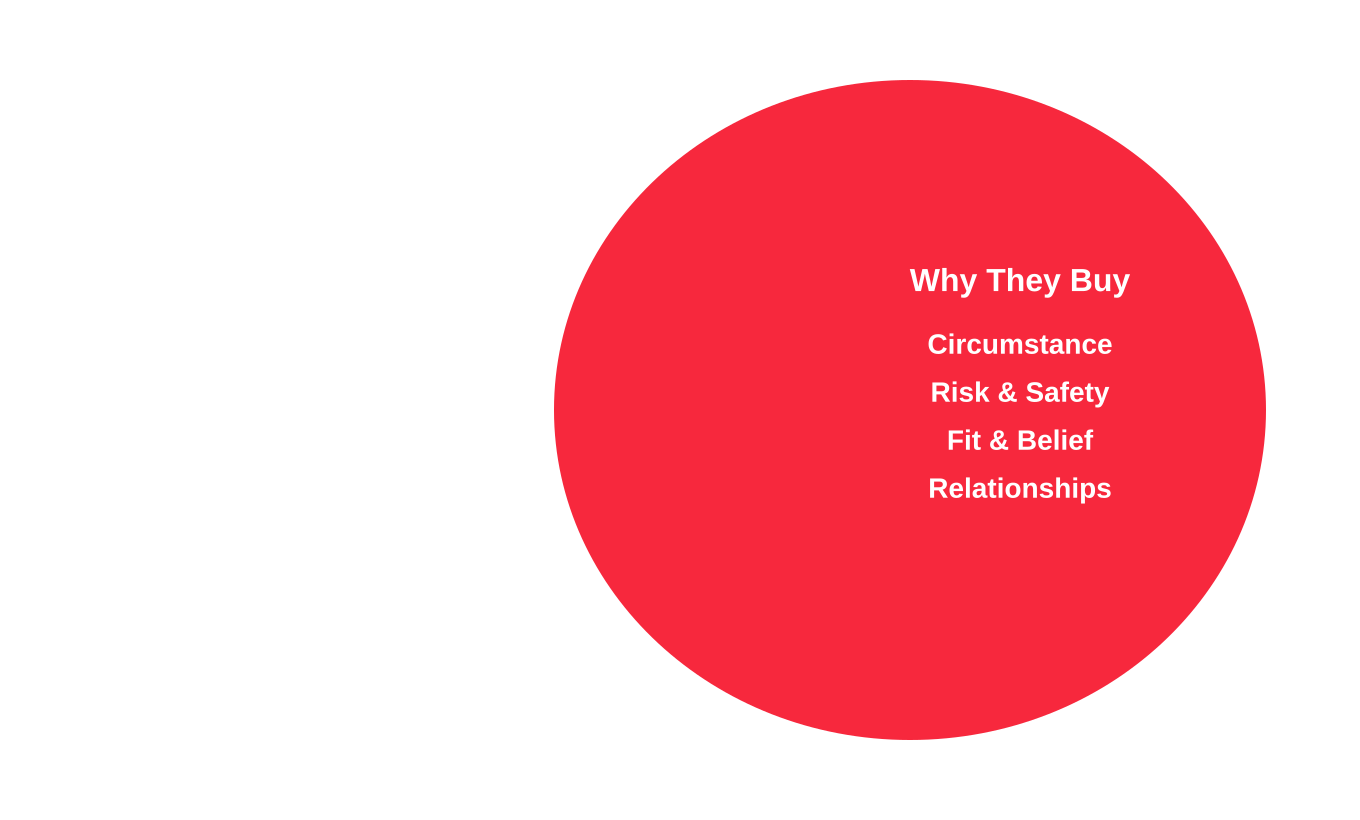
The first question is about "What We Do." The second is about "Why They Buy," and it fails in a different way.
When I push a team on what they bring to the table, I get defensiveness. They've been doing this for years and feel exposed when they can't articulate it.
When I push a team on why their best customers actually buy from them, I get something different. I get acknowledgment, nodding, and a quiet recognition that nobody’s ever actually done the work to specifically find out.
I've given a version of this talk many times. I'll tell a room that if I asked a hundred sales reps why their best customers buy from them, five would know the answer, fifteen would guess right because they’re sharp, and eighty would be shocked to learn the real truth.
Nobody's ever argued with me.
When you start pushing on why customers actually buy, the answers usually live in four different places, and most teams are vague in all of them.
First, there's circumstance. You were in the right place at the right time. Most sellers consider this luck, which is both true and, well, not helpful. What they miss is that luck at scale actually looks like a strategy. The companies whose names keep coming up when a need emerges aren't lucky. They're visible. The cast is wide, but the net has a shape.
Then there's risk and safety. The real version isn't about the company, it's about the person who made the call to buy. Buyers need a story they can tell if it doesn’t go well, and a feature list is not the same as a defensible narrative. Your best customers didn't just decide your solution was good. They decided that choosing you was a bet they could defend. Appreciate that difference.
There's fit and belief. This is the moment evaluation stops, and imagination starts. Somewhere in the process, a buyer stops weighing options and starts picturing themselves on the other side of the decision. That shift isn't triggered by a fancy website and a price point. It's triggered by feeling accurately seen.
Finally, there are relationships and social proof. Teams almost always treat these as the same thing, and they're not. A relationship is a foundation you've already built. Social proof is what signals to a stranger that you're worth building one with. One gets you in the room. The other is what makes you nearly impossible to displace once you're there.
Most companies won't do the work to broach these topics because they’re afraid of what they might hear. Those who do it are the ones who get to grow on purpose, rather than by accident.
The diagram
Now we put them together.
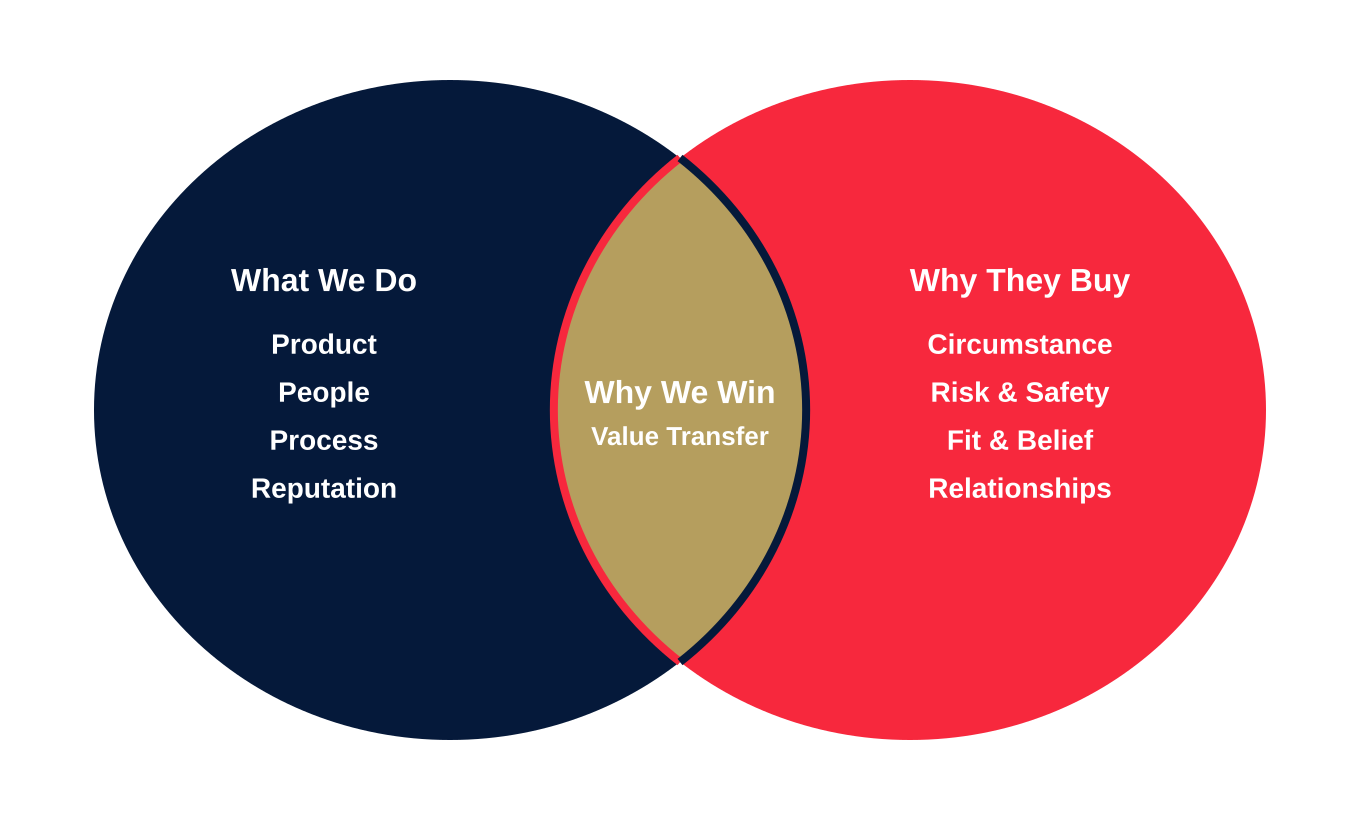
What We Do. Why They Buy. The overlap is Why We Win.
Most people will look at this diagram and assume the overlap represents the number of customers they have. That’s not it. The overlap represents value transfer. How much of what you actually do lands with the people you're serving, and how much of what they’re actually looking for gets met by what you offer.
A small overlap is luck. It means you are winning some customers, but the win is partially accidental, because the assumptions in both circles are doing too much of the work. It takes intention to sustainably increase the size of that overlap. It means you understand both circles, and you start lining them up on purpose.
The bigger overlap does not necessarily mean more customers. It means stronger value transfer with the right ones. More loyalty, higher margins, and better fit. Customers who pay full price, send referrals, and stay longer because they actually feel met.
That’s the real prize, and the path to it runs through both circles, not just one.
What Good Looks Like Here
When you’ve done the work on both, when the assumptions have been replaced with evidence, and the language has been replaced with specifics, you will have built something. Not a framework, not a methodology imported from somewhere else. The honest, articulated, teachable version of why your company wins, in your market, with your customers.
That is what I mean when I say "What Good Looks Like Here."
WGLLH is not the diagram. WGLLH is what you have when the diagram is no longer abstract. When you can describe what you do with the same precision a stranger would demand. When you can describe why your best customers buy in their own words, not yours. When the overlap is something you understand, not something you hope is there.
If you want the playbook for actually doing this, Know Why You Win is where I lay out the work.
Most companies don’t have this. They’re running on a combination of inherited momentum and individual instinct. That’s not a criticism, it’s a description of how most sales organizations actually work. That’s historically been enough to get a company a long way.
But it’s not enough to scale. It’s not enough to onboard a new rep without losing six extra months. It’s not enough to survive the retirement of a veteran whose knowledge nobody ever wrote down. It’s not enough to hold pricing in a market where every competitor is making the same three claims you are.
What is understood does, in fact, need to be discussed. The discussion is the work. And the work is what produces the clarity that leads to everything else.
What it feels like on the other side
I want to close on the part that doesn’t get talked about enough.
Leaders who do this work describe a feeling I would call relief.
It’s not the relief of having found a new answer. It’s the relief of seeing that the dots were already on the board; they just hadn’t been visible, and now they are. Once they’re visible, the leader can do the part of the job that is actually theirs: connecting them.
That’s the difference between a consultant who walks in and tells you what good looks like generically, and a process that helps you recognize what good already looks like in your own organization. The first one adds dots. The second one makes the existing dots visible. The first one feels like another initiative. The second one feels like permission to finally move.
The team feels it too. They stop being told what to do and start being seen for what they already do well. Veterans who have been winning on instinct get their instincts named and honored. Newer reps stop guessing at what good looks like and start getting coached against a meaningful standard. Everybody gets to be on the same team, working from the same picture, instead of running their own private interpretation of what the company is supposed to be.
The next training the team takes, on prospecting, LinkedIn, time management, or whatever else, has somewhere to land. All of those trainings are worth doing, but none of them work if the foundation underneath them is fuzzy. With the foundation in place, they become precise instruments instead of activities that don’t end up taking you anywhere.
Connecting the dots is your job. The work is making sure the dots are visible.
The companies that win consistently are the ones that understand both circles and deliberately design for maximum overlap, rather than assuming good work will take care of itself.
Where are your team's gaps?
You've read the argument. The next move is finding out where your team stands on both circles in your market.
The Know Why You Win Self-Assessment is the lightweight version of the diagnostic.
Ten minutes. Immediate results.
